The Workbench

I have a habit of turning “what if?” into “let’s find out.”

I’ll admit it. My brain rarely has just one idea on the go.

One minute I’m exploring AI agents, the next I’m designing something to make life easier for neurodivergent people, and before I know it, I’ve disappeared down another rabbit hole.

But that’s how I learn.

I experiment. I break things. I rebuild them. I ask questions, challenge what I’ve made and sometimes discover that the original idea wasn’t the best one after all.

I’m not a traditional software developer, and I don’t pretend to be.

I’m someone who understands problems, gets curious about possibilities and uses the tools available to turn ideas into working experiments.

Some become products. Some stay prototypes. Some are still sitting in a GitHub repository waiting for me to decide what to do with them.

All of them teach me something.

Welcome to my workbench.

From ideas to award-winning builds

Two hackathons. Two wins. A lot of curiosity.

When I started exploring AI and building things, I didn’t have a traditional technical background.

What I did have was curiosity, ideas and a willingness to try.

Hackathons became an opportunity to put that into practice. To work with a challenge, think creatively, build under pressure and see what could happen.

And two of those experiences resulted in winning projects.

But what I’m most proud of isn’t simply winning. It’s proving to myself how much is possible when you combine curiosity, lived experience, an understanding of real problems and the willingness to experiment.

Inside the workbench

Some ideas were too interesting to leave in my head.

These are some of the things I’ve been building, testing and thinking about.

They’re all at different stages. Some are live. Some are prototypes. Some are paused. Others are experiments that might become something bigger.

And I’m perfectly comfortable with that. Not every idea needs to become a company, a product or the next big thing. Sometimes the value is in what you discover while making it.

6 builds shown

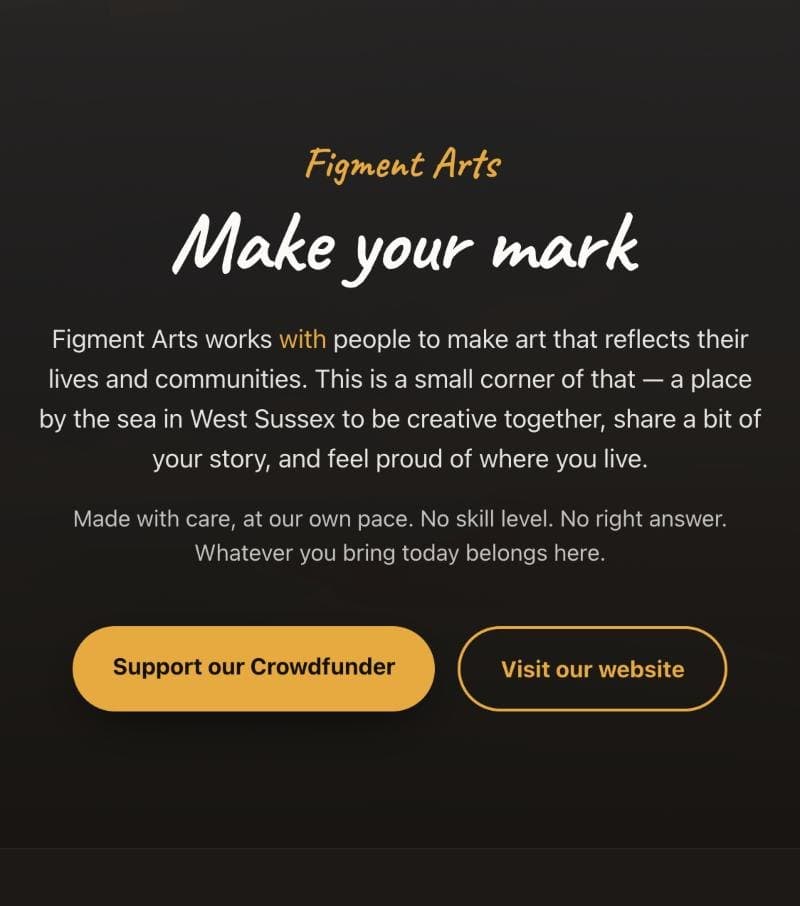
The Make Your Mark welcome screen, headed “Figment Arts. Make your mark.”

Tech for Good / Creative Technology · Hackathon-winning build

Make Your Mark

What happens when creativity and technology meet a real community challenge?

A community art web app for Figment Arts, built at the Create With × EVOLVE Tech for Good Hackathon in Brighton.

Screenshot placeholderCatch the wobble before the crash.Screenshots on their way

AI Tools / Business Support / Neurodivergent Accessibility · Hackathon-winning prototype

Wobbl

Catch the wobble before the crash.

A capacity-aware business triage tool for overwhelmed solo founders and small business owners, designed neurodivergent-first.

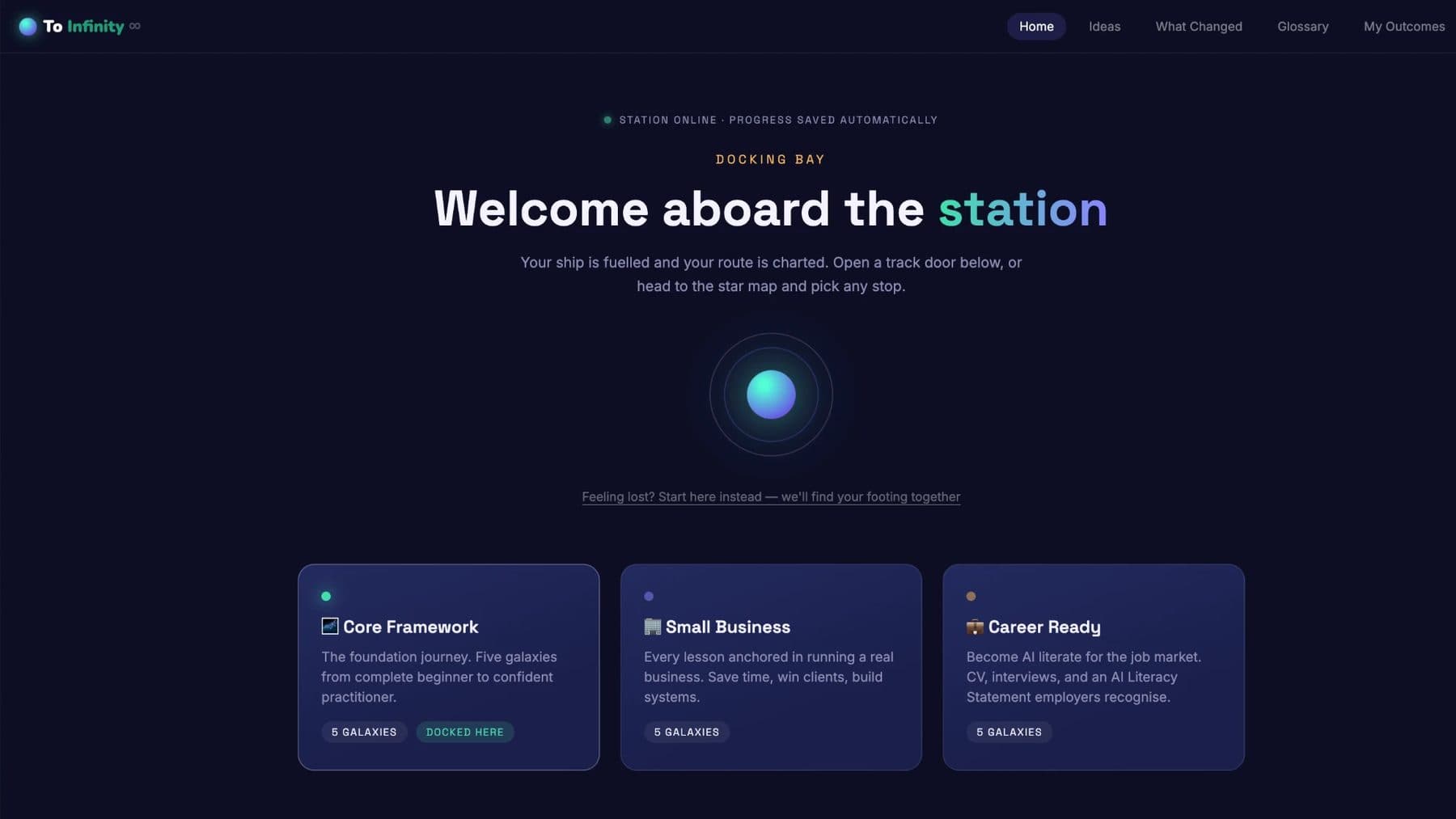
The To Infinity docking bay: “Welcome aboard the station” above three track doors, Core Framework, Small Business and Career Ready.

AI Literacy / Accessible Learning · Beta

To Infinity

AI confidence, one level at a time.

A space-themed AI literacy platform designed to make learning about AI feel less intimidating and more accessible.

Illustration of Jarvia as a holographic female AI assistant: a luminous close-up face and shoulders in plum and raspberry light, ringed by floating interface circles.

AI Assistants / Personal Systems · In use · exploring agents

Jarvia

Because apparently my brain needed its own AI assistant.

My ADHD-first AI assistant, built with Claude Code in the terminal with Obsidian as a home base.

Screenshot placeholderWhat if technology worked with our brains instead of against them?Screenshots on their way

Neurodivergent Support / Accessible Technology · Live prototype · Built in 2025 · Currently paused

Comfortably Chaotic Companion

What if technology worked with our brains instead of against them?

A neurodivergent-first support prototype: a calmer, lower-pressure space shaped by lived experience.

Screenshot placeholderSome ideas need a little more time before they meet the world.Screenshots on their way

Independent Experiment / Private Project · Private · exploring future release

Indefinite

Some ideas need a little more time before they meet the world.

An independent project I’m continuing to explore behind the scenes.

How Wobbl works

Less juggling. More clarity.

Wobbl was built around a simple question.

What if a business tool considered how much capacity you actually had before telling you what to do?

Stage 01 of 06

Make it yours

Users set up their role, responsibilities, tools and business plates.

  • Default plates include Client Work, Admin, Marketing, Sales and Finance
  • Plates can be renamed, removed and ranked by importance

Wobbl doesn’t just tell you what’s wrong. It helps you take the next step.

Under the bonnet

The prototype uses the Claude API and structured JSON responses.

AI requests consider the user’s profile, prioritised plates, available capacity, brain dump, pasted content and outstanding loops. The response includes plate statuses, recommendations, actions, estimated times and follow-up information.

The design follows calm, low-stimulation, dyslexia-friendly and reduced-motion principles.

Wobbl is a hackathon-winning prototype, not an independently validated or production-ready business system.

Lessons from the workbench

A working demo isn’t the same as a finished product.

Building with AI has made ideas feel more achievable. But it’s also taught me something equally important.

Just because you can build something quickly doesn’t mean it’s ready for people to depend on.

A prototype might look brilliant. Then you start asking questions.

  • What happens when the AI makes a mistake?
  • What information does it need access to?
  • Is it accessible?
  • Can somebody understand how to use it?
  • Is it secure?
  • Does it genuinely help, or have we just created another complicated tool?

These are the questions that interest me just as much as building the technology. And they’re part of why I care so deeply about responsible AI, governance and human-centred design.

I’m excited by what these tools make possible. But I also want to understand where they fall short.

Because there’s a difference between building something impressive and building something useful.

“A working demo proves something is possible. It doesn’t automatically prove it’s ready for the real world.”

Beyond the builds

The other things keeping my brain busy.

Writing / AI commentary

Beyond the Prompt

I spend a lot of time following what’s happening in AI, questioning the headlines and wondering what it all actually means for businesses and everyday people.

Beyond the Prompt is my LinkedIn newsletter, where I explore AI developments, responsible adoption, governance and the questions that don’t always make it into the hype.

Not just what’s changed. Why it matters, who it affects and what we should be thinking about next.

Read Beyond the Prompt (opens in a new tab)

Community / Education / Inclusion

Her Future in AI

AI is reshaping the world, but not everyone feels they have a place in the conversation.

Through Her Future in AI, which I’m building alongside my co-founder, I’m helping create opportunities for women to learn, explore, connect and shape what happens next.

From curious beginners to women already working in technology, I want more women to feel that the future of AI belongs to them too. Because it’s not enough to teach people how to use AI. We also need to make sure they have a voice in how it develops.

Explore Her Future in AI (opens in a new tab)

Currently down the rabbit hole

The curiosity doesn’t really switch off.

My workbench is never completely finished.

I’m curious about what becomes possible when AI can work across tools and systems. But I’m equally interested in the questions that come with it.

It’s exciting, sometimes overwhelming and constantly changing. Which probably explains why I keep exploring it.

Open tabs

  • AI agents
  • Personal knowledge systems
  • Responsible automation
  • Accessibility
  • AI that moves beyond answering questions into supporting meaningful action

Questions in the margin

  • Who controls the actions?
  • What happens when an agent makes a mistake?
  • How do we protect personal and business information?
  • And where should humans remain firmly in control?
An open invitation

Got a curious mind too? We should probably talk.

I’m always experimenting with something. Sometimes it’s a new AI tool. Sometimes it’s an idea for an app. Sometimes it’s a question that’s been sitting in my brain for weeks and I just need somebody equally curious to explore it with.

And while I love building, I also know that ideas get better when other people get involved.

I’m always interested in connecting with people who enjoy testing ideas, giving constructive feedback, challenging assumptions or having a good brainstorming session.

Maybe you’re interested in becoming a beta tester for something I’m building. Maybe you’ve spotted a problem that technology could help solve. Maybe you’re a developer, designer, founder or just someone with an interesting perspective. Or maybe you’ve got one of those “what if we could…” ideas that won’t leave you alone.

I’d love to hear it.

Not every conversation needs to become a project. Sometimes the conversation itself is where something interesting begins.

Let’s talk

What’s possible when we start asking better questions?

Whether you’re exploring AI for your business, experimenting with something new or wondering whether an idea is worth building, I’m always open to an interesting conversation.

I don’t believe we need to have all the answers before we start exploring. Sometimes we just need the curiosity to ask the first question.

Prefer email? hello@charlieruttle.com